Most wedding photos are experienced twice-removed from the event itself — taken in the moment, then viewed later, often much later, once a gallery is finally compiled and shared. This delay is so standard that most couples don’t think to question it. But there’s a specific, different kind of magic that happens when photos appear not later, but live, projected on a screen while the celebration is still happening around them. Wedbox’s live slideshow feature is built around exactly this idea — and it changes the texture of a reception in ways that are worth understanding.
What’s Lost When Photos Only Appear Later
The reception loses a natural, ongoing visual thread. A wedding reception spans several hours, and without something actively evolving on display, the visual experience of the room stays largely static after the initial décor is set. A slideshow that updates throughout the night gives the room something quietly alive to look at, beyond the same fixed backdrop.
Guests lose the immediate feedback loop of contribution. When someone uploads a great candid shot, the standard experience is: nothing visibly happens. The photo disappears into a shared album that may or may not be checked later. There’s no moment of recognition, no small reward for having captured something worth sharing.
Quieter guests — who may not be on the dance floor — have less to engage with. Not every guest at a wedding wants to be dancing for the entire reception. A live slideshow gives guests who are seated, chatting, or simply taking a breather something genuinely engaging to watch, drawing them back into the collective experience of the event even when they’re not actively participating in the more energetic parts of it.
The sense of “the album is growing right now” is entirely absent. There’s a specific kind of collective enjoyment that comes from watching something be built in real time together — and a wedding photo album that only becomes visible days or weeks after the fact never gets to create that particular feeling, no matter how good the final collection turns out to be.
What the Live Slideshow Actually Adds
Immediate Visual Feedback Turns Uploading Into Part of the Celebration
When a guest uploads a photo and then, minutes later, sees it appear on the big screen in front of the whole room, something shifts. Photo-sharing stops being a slightly abstract, after-the-fact administrative task (“remember to send the couple your photos”) and becomes an immediate, visible contribution to the shared experience of the night — closer to participating in a group activity than filing away content for later.
This small feedback loop meaningfully increases how many guests actually bother to upload throughout the event, compared to a passive request to share photos “at some point.” People are simply more motivated to participate in something with visible, immediate payoff.
A Natural, Evolving Focal Point in the Room
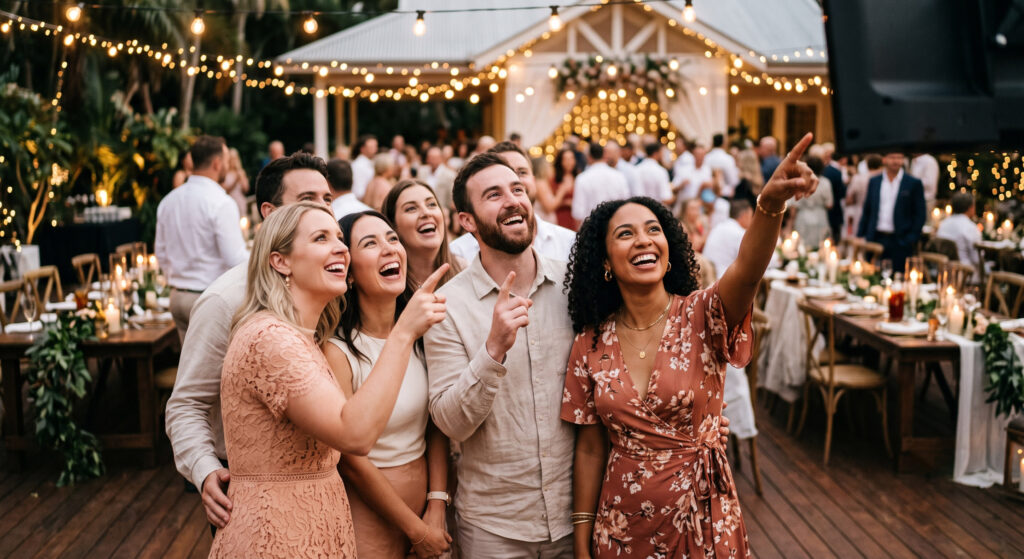
Rather than staying visually static after the initial setup, a reception with a live slideshow has something genuinely changing throughout the evening — new photos appearing, familiar faces and moments cycling through, guests occasionally pointing and laughing as they recognize themselves or friends on screen. This adds a layer of ambient visual interest to the room that a purely static setup can’t replicate, without requiring any additional planning or décor budget beyond the screen itself.
One Photo at a Time Keeps It Genuinely Watchable
A slideshow that cycles through a single large image at a time — rather than a busy, constantly-shifting grid — is meaningfully easier to actually watch and enjoy from across a room. Guests can glance up, see one clear photo, register what’s happening in it, and glance back down, rather than needing to focus intently to parse a cluttered, simultaneous grid of small thumbnails. This single design choice is what makes the feature feel like a genuine ambient presence in the room, rather than a distracting visual mess competing for attention.
It Includes Every Source, Not Just One
Because the live slideshow pulls from the same shared album that guest uploads, photographer contributions, and photo booth shots all feed into, it naturally becomes a rotating showcase of the entire day from every angle — not limited to only professional shots (which typically aren’t even ready yet during the reception itself) or only guest candids. Early in the evening, it might show photos from the ceremony just uploaded by a guest sitting near the front. Later, it might cycle through photo booth shots taken minutes earlier by a group of friends still visible on the dance floor.
Real-World Application: How This Plays Out at an Actual Reception
Picture a reception where the couple has set up a large screen near the edge of the dance floor, running the Wedbox live slideshow throughout the evening. During the earlier, quieter part of the reception — dinner, toasts — the slideshow cycles gently through photos from the ceremony that guests uploaded just an hour earlier, giving seated guests something to glance at and comment on between courses.
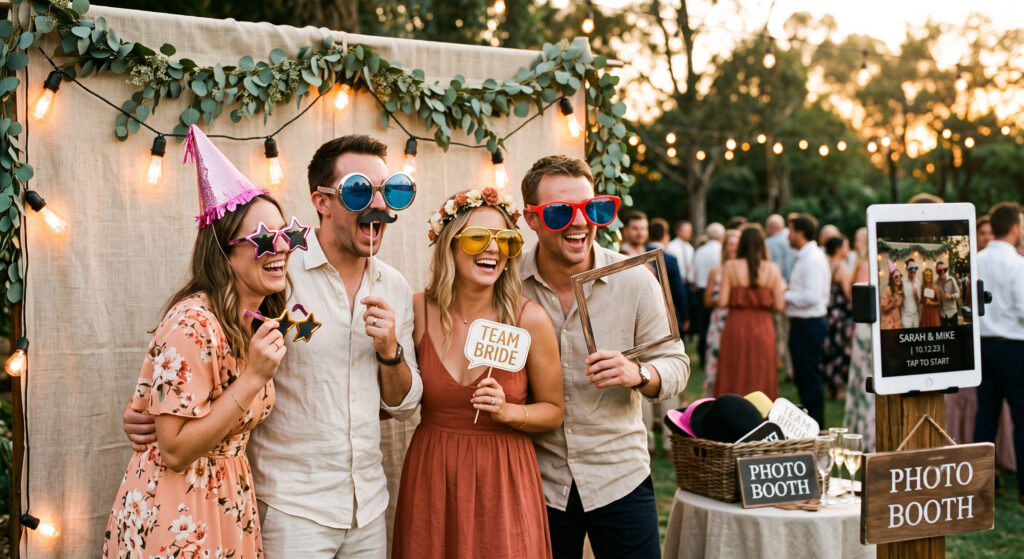
As the evening shifts toward dancing, photo booth shots start appearing in the rotation almost as quickly as they’re taken — a group of friends who posed for a silly photo minutes earlier suddenly sees it appear on the big screen, prompting laughter and a round of guests pointing and calling out to each other. A grandmother, seated for most of the night, spends a meaningful portion of the reception simply watching the screen, seeing moments from parts of the celebration she wasn’t able to be physically present for — a candid shot from cocktail hour, a photo booth moment from earlier in the night.
By the time the reception winds down, the slideshow has cycled through several hundred photos contributed by dozens of different guests throughout the night — none of it requiring any additional coordination from the couple beyond setting up the screen at the start of the evening. The room has had a continuously evolving visual thread running through it for hours, entirely generated by the people actually there, rather than a single static backdrop unchanged from the moment the reception began.
The Takeaway
A wedding reception is, at its core, a room full of people creating and experiencing something together in real time — and a live photo slideshow extends that same real-time, collective quality to the photo-taking itself. Rather than photo-sharing existing as a slightly disconnected administrative task handled before or after the actual celebration, it becomes part of the celebration itself: visible, immediate, and genuinely shared by everyone in the room as it happens.